What the World Cup in the USA and the Mashinani Cup in Korogocho Tell Us About Football
EXECUTIVE SUMMARY
On one side, a halftime show with the most expensive artists in the world. On the other, a groaning single speaker on a dusty, stone-covered pitch: This Sunday, July 19, 2026, the football world stands still: at MetLife Stadium near New York, Spain and Argentina meet in the FIFA World Cup final, in front of more than 80,000 spectators in the stadium and an estimated one-fifth of the world's population in front of screens.
Two Halftime Breaks
In East Rutherford, New Jersey, a lineup of the world's most expensive artists takes the stage at halftime of the World Cup final. Stage technology, choreography, lighting — everything planned down to the second, everything, in the best and worst sense, perfect.
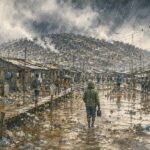
In Korogocho, a halftime break looks different. The pitch is dusty, littered with small stones, the lines barely visible to the naked eye. Music plays anyway — from a single, groaning speaker that has been known to make Western visitors cover their ears, because it blares louder than it really can. Nobody here would call it a show. It's simply: a break, some music, a few minutes to catch your breath before play resumes. It is exactly in this difference — between staged perfection and raw immediacy — that this piece finds its core.
Because this Sunday, July 19, 2026, the football world stands still: at MetLife Stadium near New York, Spain and Argentina meet in the World Cup final, in front of more than 80,000 spectators in the stadium and a billion-strong audience on screens. A few weeks earlier, on June 23, 2026, another final wrapped up in Korogocho, Nairobi's third-largest slum: the Mashinani Cup final, organized by the Mashinani League under its president Julius Tamree, officially supported this year for the first time by the German non-profit SlumChangers. No billion-strong audience, no stage show, no $50 million prize money — instead, 210 young men, a lean budget, and an audience of around 200 neighbors gathering pitch-side every Monday and Tuesday.
A Final With a Global Audience
MetLife Stadium seats over 80,000 people and cost roughly $1.6 billion to build. The final between Spain and Argentina is expected to draw a global audience in the billions; the 2022 final in Qatar alone was watched by around 1.5 billion people, and analysts expect an even larger reach in 2026. This year, FIFA is distributing a record prize pool of $871 million among the 48 participating national federations, including $50 million for the champions' federation alone. Sponsorships, broadcast rights, and ticketing are all part of a commercial ecosystem that FIFA estimates will generate more than $11 billion in revenue over the current four-year cycle. Even the halftime show is part of this machine: highly paid global stars, for a few minutes of entertainment between two halves.
These figures are not an end in themselves. They show the sheer force with which a single match can hold the world's attention. And they form the backdrop against which the second final in this piece takes on its own meaning.
A Final Without Television Cameras
The Mashinani Cup 2026 ran from May 25 to June 23 — a four-week tournament with a clearly structured schedule. Teams such as Wakulima RZA, Sansiro Maldives, Bufu FC Indomitable, Kungfu Boys Hong Kong, Udinese CF Kavirondo, and Kisumu Team Ganji competed against each other, with two additional spots reserved for the best runners-up from the group stage. The tournament's slogan, "Where Football Ignites Transformation," says it all: the Mashinani League describes itself as a "Community Based Organisation" and brings 210 young men into a regular competition. Every Monday and Tuesday, around 200 spectators from the neighborhood come together — no billion-strong audience, but a reliable, recurring one.
Julius Tamree, who founded the league together with friends, describes its essence with disarming simplicity: "It's a community thing." That is exactly where the difference to the World Cup lies. While a billion-dollar business celebrates its peak in New Jersey, the Mashinani League in Korogocho organizes public welfare — a reliable alternative to idleness, crime, and substance abuse, as slumchangers.org puts it. The budget for this is deliberately kept lean. The point is not to appear bigger than it is, but to become more precise in what it actually delivers.
TEDS COMMUNITY HUB: The Other Arm of the Same Idea
Alongside the Mashinani League, it is above all TEDS COMMUNITY HUB that shows how football works as a tool in Korogocho. Founded by Teddy Omondi, the organization combines its football work — the Teds Soccer Academy — with hot meals, a small library, and open doors from Monday to Saturday. The coaches, Omondi says in interviews, are not just "football teachers." They become mentors, people young players can talk to about things they might not discuss at home. As korogocho.com puts it, the ball is often just the "hook" — the real goal is education, belonging, a safe place.
Here too, the contrast to the World Cup is stark: in New Jersey, football is the product this Sunday. In Korogocho, it is the means.
The Sound of the Slum's Youth
How strongly this sense of belonging carries is hard to capture in numbers — but easy to hear in music. On the YouTube channel @slumchangers and in the music project @krgomusic, songs emerge that capture exactly this pride: the feeling of being part of a team, a neighborhood, a movement that organizes itself. KRGOmusic — the name stands for Korogocho — grew out of a simple observation: a European who has been a regular visitor to Korogocho for years noticed that there were hardly any songs about the slum, neither in Swahili nor in English. Using artificial intelligence, he has since been producing music that fills this gap — not to speak about Korogocho, but to express his admiration and respect for the young people driving change there every day.
The song "Our Game – Our Pride" captures exactly the contrast that runs through this piece. A stadium announcer opens it with the lines:
"Hakuna golden gates. Hakuna VIP seats. Hakuna ticket ya kuumiza watu."
(No golden gates. No VIP seats. No ticket that hurts people.)
And the chorus goes:
"Hakuna VIP, hakuna gate ya bei kali, tunacheza na love, si kucheza na chuki."
(No VIP, no gate with a harsh price — we play with love, not with hate.)
The song ends as it begins: with a chant of "Football for the people! Football every day!" — a line that reads almost like a rebuttal to the billion-dollar stage in New Jersey, without needing to be meant that way. It simply describes what actually happens in Korogocho every Monday and Tuesday.
A song like this, drawing on the energy of the Mashinani League, carries something numbers cannot express: the pride of a youth celebrating its own final — without confetti cannons, but with genuine investment. That pride, not prize money, is the currency initiatives like the Mashinani League or TEDS COMMUNITY HUB deal in.
Two Finals, One Truth About Football
So what still connects New Jersey and Korogocho when budget, audience, and stage differ so dramatically? The answer lies deeper than the sporting level. Both finals organize the same basic human need: belonging, ritual, a shared date on the calendar. The difference is reach — not the value of the experience. For a child in Korogocho, the Mashinani Cup final is no less real, no less significant than it is for a fan at MetLife Stadium. It is simply smaller. And perhaps that is exactly the point: grassroots football doesn't need to be big to be effective.
The partnership between SlumChangers and the Mashinani League, official for the first time this year, embodies this idea. Thomas Schwarz, chairman of SlumChangers, puts it this way: the organization doesn't dictate anything; the ideas emerge locally — help is given when it is asked for and when it is possible. It is an attitude that deliberately sets itself apart from the force of the big stage: not overshadowing, but strengthening what already carries itself.
Questions and Answers
What is the Mashinani Cup 2026?
A four-week football tournament organized by the Mashinani League in Korogocho, running from May 25 to June 23, 2026, that brought together 210 young players and a regular audience of around 200 spectators.
Who is behind the Mashinani League?
Julius Tamree, who founded the league at age 17 together with friends, without any outside support, and who still leads it today as president.
What sets the Mashinani Cup apart from the World Cup final?
Above all, the scale: the World Cup's prize money, audience, and infrastructure are global and worth billions, while the Mashinani Cup runs on a lean budget and local reach. The social function — belonging, structure, an alternative to idleness — is central in both cases; only the scale differs.
What role does TEDS COMMUNITY HUB play in this comparison?
Founded by Teddy Omondi, TEDS COMMUNITY HUB also uses football as a gateway to education, meals, and mentoring, offering a second, complementary approach alongside the Mashinani League in Korogocho.
What is KRGOmusic, and what does the song have to do with the topic?
KRGOmusic (short for Korogocho) is an AI-produced music project by a European who has been a regular visitor to Korogocho for years. It started from the observation that there are hardly any songs about the slum — neither in Swahili nor in English. The songs musically capture the pride and sense of belonging that the Mashinani League and TEDS COMMUNITY HUB create in everyday life in Korogocho — far removed from broadcast rights and prize money.
Sources
- korogocho.com – Third Largest Slum / TEDS COMMUNITY HUB
- slumchangers.org – Mashinani League
- slumchangers.org – An Anthem for the Mashinani League (Mashinani Cup 2026)
- tedssoccer.org – Teds Soccer Academy
- thomasschwarzbonn.de – The Children of Korogocho
- YouTube @slumchangers and @krgomusic – interviews with Teddy Omondi and Julius Tamree
- KRGOmusic – "Our Game – Our Pride" (song)
- FIFA – FIFA World Cup 2026 Final
- Forbes, CNBC, SI.com, ESPN, Al Jazeera – prize money, viewership figures, stadium data, World Cup 2026