The Work Was Already Under Way
Nairobi has opened applications for youth climate grants. In Korogocho, young people have been cleaning, planting and restoring shared spaces for years. Could their work find support?
25 September 2026 · Korogocho.com
A new opportunity across Nairobi
Nairobi City County has published the application template for its 2026–2027 Youth Climate Action Fund. Young people aged 15 to 24 can propose local climate projects, with individual microgrants of US$1,000 to US$5,000. The county says US$50,000 is available for Nairobi as a whole and gives 16 October 2026 as the closing date. The publication of a form turns an announcement into a practical opportunity: groups can now set out what they want to do and what it would cost. It does not mean that Korogocho has received a grant.
Korogocho’s environmental work has a history
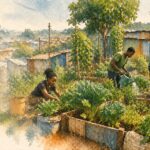
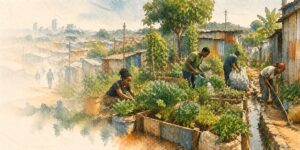
In Korogocho, the WAKULIMA YOUTH GROUP did not wait for a climate fund to begin. Its members cleared an area between homes where rubbish had accumulated and began to plant it. They clean streets, collect plastic and metal for sale, and use the proceeds to buy tools. They also grow vegetables. The garden and the work around it are small in scale, but they belong to the people who started them. Korogocho.com has documented this work; it is not evidence that WAKULIMA has applied for the new funding.
Another stretch of land, another initiative
Along the Nairobi River, KOMB Green Solutions offers a different example. Members cleared a former dumping area and helped create People’s Park, a green space that includes an urban garden. Published research describes the riverbank clean-up, planting and community use of the site. Neither example should be turned into a claim that a grant alone can solve Korogocho’s waste, water or drainage problems. Both show that local knowledge and practical work already exist.
What could an application look like?
A proposal could build on an existing garden, establish a small and maintainable recycling point, protect a specific drainage route from dumped waste, or involve young people in tending a shared green space. These are possibilities, not announced applications. A credible plan would identify one site and the people responsible for it, list realistic costs, explain how the work would continue after the microgrant, and describe what residents could verify. Before applying, groups should read the official template closely, including any rules on eligibility, partnerships, budgets and submission.
Access matters as much as the announcement
A citywide call does not guarantee an equal chance to take part. Preparing an application takes time, internet access, a workable budget and sometimes administrative support. The county should make its requirements and selection process clear enough for smaller neighbourhood groups to navigate. A group that already cleans a passage or tends a garden may have a stronger practical record than a polished proposal suggests, yet still need help documenting it. Whether such groups receive that help is an open question.
The test comes after selection
For now, the fund is an opportunity, not an outcome. There is no published evidence that a Korogocho group has applied, that the neighbourhood will be preferred, or that any money has reached it. After the awards, the questions should be concrete: Which groups won? Where will the projects operate? Were funds paid? What changed on the ground, and did the work last? The county and the funders have an interest in presenting the programme positively; independent reporting will have to examine its reach and results.
Questions and answers
Has Korogocho received funding? No award to a Korogocho group has been established.
Who can apply? According to the county announcement, young people aged 15–24. Consult the official template for full requirements.
When is the deadline? 16 October 2026, according to Nairobi City County.
Sources and further reading
- Official microgrant application template
- Korogocho.com: WAKULIMA YOUTH GROUP
- Korogocho.com: Mazingira Day
- Study: Community adaptation strategies in Korogocho
- Regreening Africa: KOMB Green Solutions
Source note: County information describes an official call, not an independent evaluation. Accounts of local initiatives document existing work; they do not confirm applications or grants.