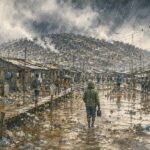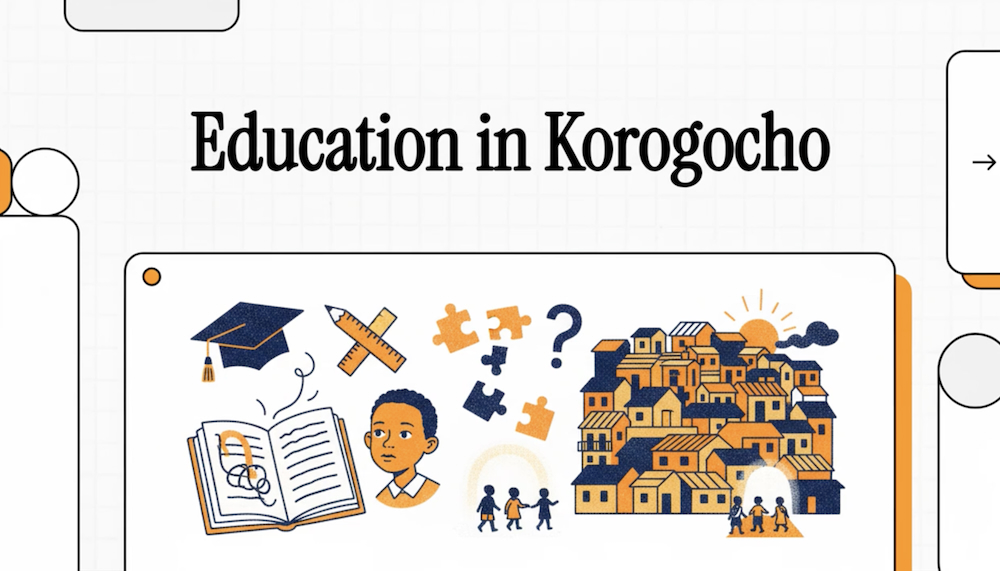
Early in the morning, when smoke rises above the Dandora rubbish dump, the day begins in Korogocho. Between corrugated iron walls, narrow footpaths and open sewage ditches, children in oversized school uniforms set off for school. The way to school takes them past improvised market stalls, houses without doors, and young people who are already waiting to sell or carry something to earn a few shillings.
Korogocho, one of the most densely populated slums in Nairobi, is located just a few kilometres from the glass towers of the city centre. And yet it seems like another world. This is where it is decided whether the Universal Declaration of Human Rights, that great promise of 1948, actually applies. Whether the ‘right to education for children in Korogocho’ is more than just a phrase in a UN document.
Korogocho: Childhood and the right to education
Korogocho is not a statistical footnote, but a magnifying glass. Issues that are visible in many fast-growing cities in the Global South are concentrated in a very small area: extreme poverty, informal work, overcrowding, unsafe living conditions, violence, drugs, lack of infrastructure. A large proportion of the residents are under the age of 18. For these children, the journey to school is not a routine activity, but a daily negotiation.
Officially, Kenya is a country with free primary education for all. In practice, parents in Korogocho face very different questions. Is there enough money for notebooks, pens and school uniforms? Is the long journey to school safe enough? And is it worth sending a child to school if it means losing a small but noticeable contribution to the family income?
The ‘right to education for children in Korogocho’ clashes with the logic of survival. When every day has to be reorganised, school easily becomes a luxury that cannot always be afforded.
The promise: Universal Declaration of Human Rights for Korogocho
When the Universal Declaration of Human Rights was adopted in 1948, the world was reeling from war, displacement and mass crimes. At that time, education was not simply ‘included’ on the list of human rights. It was a conscious decision. Article 26 of the Declaration states that everyone has the right to education, that primary education should be free and compulsory, and that education should promote the full development of the human personality and strengthen respect for human rights.
Applying this to Korogocho paints a clear picture. No child should be excluded from access to school because of their origin, place of residence or family income. The right to education is not tied to a specific postcode or social class. It applies to children in affluent neighbourhoods just as much as it does to children on the edge of the rubbish dump.
At the same time, education is never considered in isolation in the logic of human rights. The Declaration speaks of the right to life, liberty and security of person, the right to an adequate standard of living, health and social security. For Korogocho, this means that the ‘right to education for children in Korogocho’ presupposes that they can attend school without fear of violence, without constant hunger and without constant health emergencies. Human rights are a package deal; if one part is missing, the other rights become fragile.
The right to education in Kenya’s constitution – also for the children in Korogocho
Kenya has not only recognised these international obligations, but has also enshrined them in its constitution and laws. The 2010 constitution explicitly includes education among the fundamental social rights. Every child is entitled to free and compulsory basic education. The Basic Education Act specifies this promise and obliges the state not only to offer education, but also to ensure that it is actually accessible.
On paper, this sounds like a success story. The constitution, education law, international human rights agreements and the United Nations’ sustainability goals all intertwine. The ‘right to education for children in Korogocho’ is not only morally but also legally guaranteed.
But in the reality of the slums, there is a clear gap. In many informal settlements, there are too few state schools, classes are overcrowded, buildings are dilapidated, and teachers are understaffed. Private low-fee schools fill the gap, but they charge fees that are prohibitive for families living on the breadline. Tuition may be free, but uniforms, exam fees and ‘small contributions’ add up to an amount that poorer households cannot afford on a regular basis.
The path to secondary school exacerbates this divide. Secondary schools are often far away, and transport is expensive and unsafe. At this level, the ‘right to education for children in Korogocho’ loses its practical significance for many. Legally, the transition is possible, but in reality it remains blocked for many.
Girls in the slums: when the right to education reaches its limits

This tension is particularly evident in the case of girls. Hundreds of thousands of girls grow up in the slums of Nairobi, many of them in unsafe, precarious conditions. For them, gender-specific vulnerability adds to poverty.
Early pregnancies are no exception in Korogocho. For a girl who becomes pregnant at 15 or 16, the journey to school becomes a barrier of shame, stigmatisation and simple overload. Who will look after the child while the mother is in class? Who will pay the additional costs when the income is barely enough as it is? Which school is willing to take a young mother back?
Human rights instruments are clear on this issue. They emphasise the right of girls and boys to non-discriminatory education, the right to continue learning despite motherhood, and protection from violence and exploitation. In practice, however, it takes an enormous amount of effort to enforce this ‘right to education for children in Korogocho’ against social norms, poverty and institutional barriers.
Girls carry something of a double burden in their lives. In many families, they are seen as a potential source of income through early marriage and, at the same time, as primarily responsible for unpaid care work. In such circumstances, education becomes an option that, from the family’s point of view, must be justified again and again. A human right should not have to be proven. But that is exactly what happens when a girl from Korogocho wants to continue going to school.
Poverty, violence, insecurity: the right to education for children in Korogocho remains fragile
Anyone who observes everyday life in Korogocho quickly understands why human rights are not abstract here. Poverty does not just mean having little money. It means the constant need to survive today instead of making long-term plans. When a child contributes to the household budget by selling goods on the street, collecting rubbish or doing odd jobs, this activity competes directly with school attendance.
Added to this is the insecurity in public spaces. The way to school can be dangerous, alleys are unlit, and gangs, drugs and violence are part of everyday life. For a child, this means that education comes with a real risk. For many families, the prospect of better opportunities in ten years’ time weighs less in the short term than the very real danger on the way home today.
The limitations of the system are also reflected within the schools. Overcrowded classrooms, too few teachers, inadequate sanitary facilities, hardly any room for individual support. Under these conditions, the ‘right to education for children in Korogocho’ is often reduced to a minimum: physical presence in the classroom, but little real participation in learning.
Local initiatives support the right to education
Despite all these hurdles, Korogocho is not a place of pure hopelessness. It is precisely here that a multitude of initiatives are emerging that attempt to bridge the gap between human rights standards and the reality of life.
The Ayiera Initiative, for example, uses football to reach children and young people from the surrounding area. What appears from the outside to be a sports programme is in fact a gateway to educational support.

Initiatives such as TEDS COMMUNITY HUB in Korogocho, a community-based organisation (CBO), are attempting to close the gap between aspiration and reality. They do not simply look after the children to prevent them from slipping into drugs and crime. With the help of the German NGO ‘One4One’, they support dozens of children from the poorest families in paying their school fees. The CEO of TDS COMMUNITY HUB, Teddy Omondi, has many years of experience as a social worker and is described by everyone who works with him as a level-headed, intelligent worker in the field of education.
The newly founded NGO ‘SlumChangers’ from Germany – led by journalist, author and human rights activist Thomas Schwarz – also supports such initiatives and groups that are committed to the education of children and young people. This includes support in managing such tasks in the slums. Schwarz has worked with and for international NGOs for over nine years.

These are just two examples of how international organisations are trying to bridge the gap between aspiration (the Declaration of Human Rights with the right to education on the one hand) and reality with concrete help – and thus contribute to greater educational justice in the Korogocho slum.
Other organisations create safe spaces for children, advise families, work with schools and fight against violence, drugs and exploitation. They combine practical assistance with a clear language of rights. Those who seek advice there not only hear what is practically possible, but also what children can legally claim.
In these projects, the ‘right to education for children in Korogocho’ is being translated step by step into concrete experiences. Into the first school notebook that no longer has to be missing. Into a father’s decision to send his daughter back to school. Into a young mother who continues her schooling despite resistance.
The right to education needs a language for children in Korogocho
An often underestimated aspect of the Universal Declaration of Human Rights is the demand that education itself should be human rights-oriented. Children should not only learn to read, write and do arithmetic, but also understand what rights they have and how they can exercise them.
In Korogocho, this is a decisive lever. Where children, parents and teachers know the language of rights, the dynamics change. Requests become demands, gratitude becomes entitlement, and isolated complaints become collective awareness. When a group of parents declares to the authorities that the ‘right to education must also be taken seriously for children in Korogocho’ because it is enshrined in the constitution, this is more than a moral appeal. It is a politically and legally justified position.
In this context, human rights education means that a child not only knows that they ‘should go to school,’ but also understands why they are entitled to this right and what obligations the state and society must derive from it.
A global test: the children in Korogocho and us
Korogocho is more than just a geographical location. It is a test case for how seriously the international community, national governments, businesses and civil society take their own promises.
The Universal Declaration of Human Rights is not a historical document to be quoted on anniversaries. It is a living standard. As long as a child in Korogocho only has a realistic chance of education if they are ‘discovered’ by an aid organisation, a scholarship programme or a committed teacher, this standard is not being met.
The ‘right to education for children in Korogocho’ therefore challenges not only politicians to invest more in schools, teachers, infrastructure and security. It also challenges companies and foundations to align their ESG and CSR strategies not with marketing, but with the question of whether they contribute to closing such structural gaps. And it challenges each and every one of us to go beyond donations and also generate political attention, public debate and pressure on decision-makers.
In the end, it all boils down to one simple, uncomfortable question: does the Universal Declaration of Human Rights also apply on the outskirts of the city, in a slum like Korogocho? Or is it a promise that is celebrated in conference rooms and forgotten in everyday life?
If the ‘right to education for children in Korogocho’ is actually fulfilled, it will not only change a neighbourhood in Nairobi. It will change our idea of what human rights mean in the 21st century: not abstract ideals, but concrete opportunities – for every child, everywhere.